






There’s a reason Europe keeps pulling in more than 1.4 million international students annually. It delivers quality education without the price shock seen elsewhere. Public universities in Germany, France, Italy, and Austria continue to charge between €0 and €3,000 per year, a remarkable contrast to the global average of USD 15,000+. For students comparing long-term costs, this gap changes everything, from tuition to lifestyle choices, and even career planning.
This blog breaks down the cheapest universities in Europe for international students, explains why these institutions are worth considering, and offers practical insights on fees, living expenses, and smarter budgeting across the continent.
Europe’s Cheapest Universities For International Students: Quick Overview
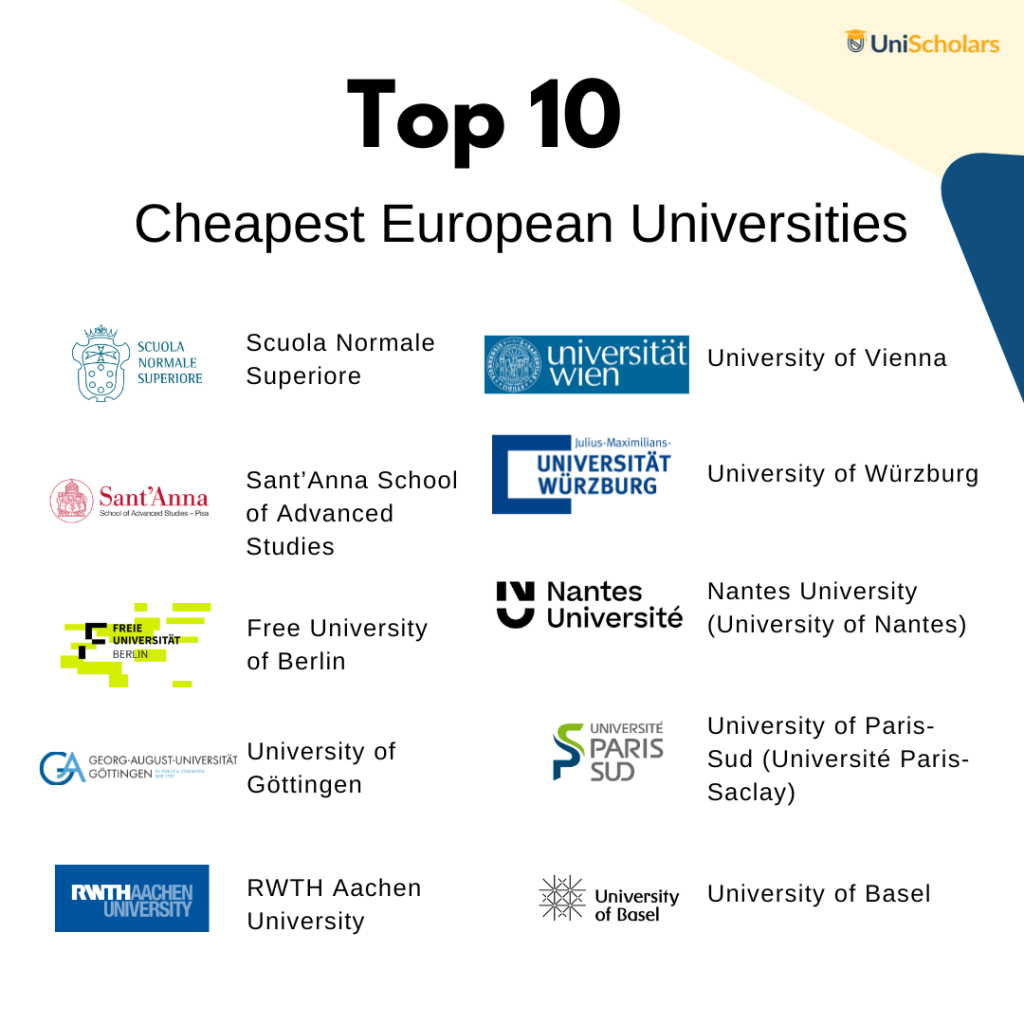
| University | Country | Approx Annual Tuition Fee (Int Students) | Key Highlights |
| Scuola Normale Superiore | Italy | Free (full financial support incl. tuition, housing, meals) | Fully funded pathway for top-ranked students Small cohorts with close academic mentorship Globally recognised research culture |
| Sant’Anna School of Advanced Studies | Italy | Free for selected students (undergraduate); ~€7,500 for MSc | Selective honours model with full financial support for eligible students Strong applied research and innovation focus 90%+ graduate employment in high-impact sectors Access to leading labs and policy centres |
| Freie Universität Berlin | Germany | No tuition fees; semester fee ~€300–€350 | German University of Excellence with global recognition 150+ English-taught or international programmes Strong research networks across Berlin’s academic hub |
| University of Göttingen | Germany | No tuition fees; semester fee ~€380–€420 | Member of the German U15 research elite Historic institution with 13 Nobel-affiliated scholars Deep links with Max Planck Institutes |
| RWTH Aachen University | Germany | No tuition fees; semester fee ~€300–€350 | Germany’s top industrial engineering destination Strong partnerships with BMW, Siemens, Airbus Excellent employability for STEM graduates |
| University of Vienna | Austria | €1,453/year (non-EU); €0 (EU/EEA + semester fee) | One of Europe’s oldest and most respected universities Wide academic range with 178 programmes Strong humanities, social sciences, and natural sciences reputation Large international student community |
| University of Würzburg | Germany | No tuition fees; semester fee ~€150–€170 | Top-tier research legacy with 14 Nobel Prize connections Strong focus on medicine, natural sciences, and psychology High-quality labs and research clusters (incl. Max Planck ties) |
| Nantes University | France | €2,770/year (Bachelor, non-EU); €3,770/year (Master, non-EU) | Strong applied sciences and tech-driven programmes Major research collaborations with CNRS and INSERM Active innovation ecosystem and modern labs |
| University of Paris-Sud (Université Paris-Saclay) | France | €2,770/year (Bachelor, non-EU); €3,770/year (Master, non-EU) | Ranked #1 globally in Mathematics Europe’s leading STEM and research ecosystem Direct access to CEA, CNRS, INRIA, INSERM labs Strong reputation for engineering, physics, and life sciences |
| University of Basel | Switzerland | CHF 1,700/year (Bachelor/Master); CHF 700/year (PhD) | Switzerland’s oldest university with a top global reputation Strong medical, pharmaceutical, and life sciences research Access to Basel’s biotech and pharma hubs Excellent academic libraries and research facilities |
Why Study at a Low-Cost European University?
- Affordability Without Sacrificing Academic Standards
Across Europe, many public universities keep tuition extremely low, and several charge no tuition at all. Public universities in Germany, for instance, charge international students only with a modest semester contribution of roughly €150–€300. With UK and US tuition often ranging from £15,000 to £30,000 per year, Europe stands out as one of the most cost-effective regions for high-quality higher education.
Want to see how far low tuition can really go? Explore German universities where international students pay minimal fees while studying at globally ranked institutions.
- Lower Living Costs Compared to the UK and the US
Day-to-day expenses in Europe are generally far lower than in major British or American cities. Most international students can budget around €992 a month for accommodation, food, transport, and utilities. This makes Europe particularly appealing for students aiming to balance academic ambition with financial practicality.
- State-Supported Tuition Models & Scholarships
Several European nations keep higher education publicly funded, enabling international students to study at highly subsidised rates. Germany, Austria, Norway, and France continue to support low-fee structures, while universities across the region offer merit awards and need-based grants to ease financial pressure for global applicants.
- High Cultural Diversity, Mobility & Global Exposure
Initiatives like Erasmus+ and the Schengen Area’s open travel zone make cross-border mobility remarkably simple. Students can take short-term exchanges, pursue internships, or attend language programmes across dozens of countries. Universities also host diverse international cohorts, creating a rich environment where academic perspectives and cultural experiences blend naturally.
- Part-Time Work Opportunities & Practical Experience
International students in most European countries can work up to 20 hours per week during the academic term. This helps offset living expenses while building valuable work experience. Many graduates transition into post-study roles or secure placement extensions, strengthening their career prospects within Europe’s competitive job market.
Also Read: A Guide To Study In Europe – Tuition Fees, Degrees, Universities
Top 10 Cheapest Universities in Europe: In-Depth
Scuola Normale Superiore
Founded in 1810 by Napoleon, Scuola Normale Superiore is one of Italy’s most prestigious institutions, known for its elite, merit-based academic training. With historic campuses in Pisa, Florence, and Cortona, it has produced global leaders, Nobel laureates, and pioneering researchers.
Global Rankings
| Ranking Body | Rank |
| QS World University Ranking By Subject 2025 | 8 |
| Times Higher Education (THE) 2026 | 137 |
| US News & World Report Best Global Universities | 374 |
Top Reasons to study at Scuola Normale Superiore
- Merit-based entry through rigorous examinations: Selection depends entirely on competitive written and oral exams, giving every applicant an equal chance regardless of school background. Talent, reasoning ability, and intellectual drive take priority over past grades or where you studied.
- Fully funded academic journey: Successful candidates receive full financial support, including tuition coverage, housing, and meals, allowing them to study without monetary pressure. Each year, dozens of international students benefit from this model, creating a level academic field focused purely on excellence.
- Early immersion in research and advanced study: SNS integrates rigorous coursework with research from the outset. Whether in humanities, sciences, or social sciences, students work in an environment built for depth, supported by one of Europe’s most extensive open-access libraries and a multidisciplinary peer group.
- Proven academic prestige and global recognition: Frequently placed among the world’s top 200 universities and consistently in Italy’s top tier, SNS has produced Nobel Prize winners, leading academics, and influential public figures, reflecting the calibre of its teaching and scholarly culture.
- Historic campuses with a powerful intellectual atmosphere: With locations in Pisa and Florence/Cortona, SNS offers a blend of historic architecture and modern research spaces. The academic community is diverse, collaborative, and intensely engaged, shaping your perspective, ambitions, and growth as a scholar.
Cost of Studying at SNS
| Course / Level | Duration (typical) | Avg Annual Tuition Fees |
| Undergraduate / Bachelor + integrated University degree | 3 years (bachelor) + subsequent years at the University if applicable | Free — university fees reimbursed; all SNS tuition is waived. |
| Master’s-level (as part of University + SNS track) | 2 years (typical for master’s programmes) | Free — no tuition fees for SNS-enrolled students. |
| Doctoral / PhD programmes | ~ 3–4 years (typical for PhD) | Fully funded — Tuition fees waived; admitted PhD students receive a scholarship covering living costs, accommodation, meals, and additional research grants, including travel reimbursements. |
Sant’Anna School of Advanced Studies
A highly selective public research institution founded in 1987, Sant’Anna School of Advanced Studies specialises in applied sciences, economics, law, engineering, biotechnology and medicine. The school, being part of the Pisa University System, blends rigorous academic training with a strong emphasis on research, innovation, internationalisation, and merit-based admission.
Global Rankings
| Ranking Body | Rank |
| QS World University Ranking By Subject 2025 | 251-300 |
| Times Higher Education (THE) 2026 | 201-250 |
Top Reasons to study at Sant’Anna School of Advanced Studies
- Competitive exams with full financial support for top performers: Entry is determined through rigorous public exams, and successful candidates receive tuition waivers, stipends, and accommodation benefits, ensuring affordability without compromising quality.
- A selective honours-college model with exceptional outcomes: Students follow tailored academic pathways, engage in intensive coursework, and receive close faculty guidance. This focused environment contributes to graduate employment rates exceeding 90%.
- Interdisciplinary training shaped by innovation and real-world impact: Courses bridge fields such as engineering, economics, political science, biotechnology, and public policy, equipping students to tackle contemporary challenges in technology, sustainability, and healthcare.
- Diverse student body with strong international mobility: Around one-fifth of Sant’Anna’s student community comes from outside Italy, benefiting from global partnerships, research collaborations, exchange programmes, and overseas study options.
- Part of a powerful academic network in Pisa: Students gain access to the broader Pisa university ecosystem, including advanced laboratories, joint research projects, and cross-campus academic opportunities with the University of Pisa and Scuola Normale Superiore.
Cost of Studying at Sant’Anna School of Advanced Studies
| Course Level | Duration (Typical) | Avg Annual Tuition Fees |
| Undergraduate / Ordinary Courses | Follows standard university track | Free. Offers full fee waivers for selected students |
| Master’s / MSc | 1–2 years | ~ €7,500 ( for full MSc programmes) |
| Doctoral / PhD | 3–4 years | Fully funded — tuition waived, scholarships + living support available |
Freie Universität Berlin (FU Berlin)
Established in 1948 in pursuit of academic freedom, Freie Universität Berlin is a German University of Excellence known for world-class research and global networks. Its Dahlem campus hosts 150+ programs across 12 departments in a tranquil, residential setting.
Global Rankings
| Ranking Body | Rank |
| QS World University Rankings 2026 | 88 |
| Times Higher Education (THE) 2026 | 113 |
| US News & World Report Best Global Universities | 59 |
Top Reasons to study at Freie Universität Berlin
- A legacy rooted in academic freedom: Founded in 1948 to champion free scholarship, FUB continues to promote open inquiry, independent thinking, and a culture where ideas are debated without constraints.
- Recognised as a German University of Excellence: The university’s Excellence status reflects its strong research performance across humanities, social sciences, natural sciences, and life sciences, giving students access to high-impact research clusters and leading academics.
- Strong global orientation and diverse student community: With more than 20% international students, extensive exchange pathways, and a wide range of English-taught master’s programmes, FUB is ideal for students aiming for internationally aligned careers.
- Nearly tuition-free study experience: Most bachelor’s and several master’s degrees come with no tuition fees, aside from a modest semester contribution, making it one of Europe’s most affordable top-tier institutions.
- A serene yet dynamic campus experience in Berlin: Set in the leafy Dahlem district, the campus offers modern research facilities within a quiet academic environment while keeping you close to Berlin’s cultural life and professional networks.
Cost of Studying at Freie Universität Berlin
| Course Offered | Duration | Avg Annual Tuition Fees |
| Undergraduate / Ordinary Courses | 3 Years | No tuition fees, semester contribution ~€300–€350 |
| Master’s / MSc | 2 Years | No tuition fees for most, some continuing-education master’s charge fees (varies by program) |
| Doctoral / PhD | 3 – 4 Years | No tuition fees; only semester contribution; funding/scholarships widely available |
Also Read: Best Universities in Berlin 2025: Admissions, Fees & Eligibility
University of Göttingen
Driven by a passion for research, Göttingen provides a robust academic foundation. As a member of the German U15 research universities and the home of 13 Nobel Prize winners, it offers an environment where ambitious students can thrive alongside leading scientists.
Global Rankings
| Ranking Body | Rank |
| QS World University Rankings 2026 | 243 |
| Times Higher Education (THE) 2026 | 122 |
| US News & World Report Best Global Universities | 182 |
Top Reasons to Study at the University of Göttingen
- Prestigious research university with a Nobel legacy: Göttingen’s strong research culture and 13 Nobel laureates create an inspiring environment for students aiming to work alongside leading scientists.
- Affordable, high-quality education: Bachelor’s and master’s programmes have no tuition fees; only a modest semester contribution (~€380–€420) covers essentials, including public transport.
- Extensive research and lab access: Partnerships with Max Planck Institutes and Göttingen’s research network give students early exposure to advanced labs, interdisciplinary projects, and world-class faculty.
- Global student support and English programs: With learners from 140+ countries, Göttingen offers guidance on visas, careers, and language support, alongside multiple English-taught master’s courses.
- Safe, student-friendly city: Nearly a third of residents are students, creating a secure, vibrant, and affordable town ideal for academic and personal growth.
Cost of Studying at the University of Göttingen
| Course Offered | Duration | Avg Annual Tuition Fees |
| Undergraduate / Ordinary Courses | 3 years | No tuition fees, semester contribution €380–€420 |
| Master’s / MSc | 2 years | No tuition fees, semester contribution only |
| Doctoral / PhD | 3–4+ years | No tuition fees, funding/scholarships available via doctoral schools & research foundations |
RWTH Aachen University
RWTH Aachen University is Germany’s largest and one of its most prestigious technical universities, recognised as a University of Excellence for its world-leading engineering and science research. Founded in 1870 and located near the borders of Belgium and the Netherlands, it hosts over 47,000 students, including 11,000+ international students. It is known for strong industry partnerships and major innovation hubs in mobility, production, energy and digital technologies.
Global Rankings
| Ranking Body | Rank |
| QS World University Rankings 2026 | 105 |
| Times Higher Education (THE) 2026 | 92 |
| US News & World Report Best Global Universities | 225 |
Top Reasons to Study at RWTH Aachen University
- Europe’s leading technical university: RWTH Aachen is Germany’s largest technical university, renowned across Europe for excellence in engineering, computer science, materials science, and industrial technology.
- Industry-driven, hands-on learning: Students gain real-world experience through labs, research projects, and partnerships with top companies like BMW, Siemens, Bosch, Ford, and Airbus.
- Cutting-edge research ecosystem: The university hosts advanced research clusters in AI, mobility, energy, production technology, and medical engineering under Germany’s Excellence Initiative.
- International-friendly environment: With 11,000+ global students, English-taught master’s programs, orientation, language support, and career mentoring, RWTH ensures smooth integration for international learners.
- Strong career prospects: Graduates are highly valued in engineering, tech, R&D, and automotive sectors due to their solid technical training and practical exposure.
Cost of Studying at RWTH Aachen University
| Course Offered | Duration | Avg Annual Tuition Fees |
| Undergraduate / Ordinary Courses | 3 years | No tuition fees; semester contribution ~€300–€350 |
| Master’s / MSc | 2 years | No tuition fees; semester contribution only |
| Doctoral / PhD | 3–4+ years | No tuition fees; funded research positions & scholarships available (DAAD / RWTH Research Centres) |
Also Read: Living Smart: Cost of Living in Germany for Students in 2025
University of Vienna
Founded in 1365, the University of Vienna is one of Europe’s oldest and most renowned research universities, known for its global strength in the humanities, social sciences and natural sciences. With 178 degree programmes and a highly international academic community, it offers modern research facilities across a historic city-centre campus in Vienna, regularly ranked one of the world’s most liveable cities.
Global Rankings
| Ranking Body | Rank |
| QS World University Rankings 2026 | 152 |
| Times Higher Education (THE) 2026 | 95 |
| US News & World Report Best Global Universities | 212 |
Top Reasons to Study at the University of Vienna
- Centuries of academic excellence: Founded in 1365, Vienna University is among Europe’s oldest institutions, renowned for humanities, social sciences, natural sciences, and psychology, with a legacy of Nobel laureates.
- Affordable world-class education: International tuition fees are low, and EU/EEA students study almost free, while Austria offers a stable cost of living and strong student support.
- Thriving international community: Home to over 10,000 international students, the university provides dedicated services to help you integrate academically and socially.
- Study in a top global city: Vienna ranks among the world’s most liveable cities, offering safety, culture, efficient transport, and graduate career opportunities.
- Diverse programs and research opportunities: With 178 degree programs and access to modern labs, libraries, and interdisciplinary institutes, students enjoy breadth and cutting-edge research exposure.
Cost of Studying at the University of Vienna
| Course Offered | Duration | Avg Annual Tuition Fees |
| Undergraduate / Ordinary Courses | 3 years | €1,453/year for non-EU; €0 for EU/EEA (semester fee only) |
| Master’s / MSc | 2 years | €1,453/year for non-EU; €0 for EU/EEA (semester fee only) |
| Doctoral / PhD | 3 years | €1,453/year for non-EU; €0 for EU/EEA |
University of Würzburg
With a history stretching back to 1402, the University of Würzburg ranks among Germany’s oldest public research universities, celebrated for groundbreaking contributions in medicine, natural sciences, and the humanities. Its campus blends historic charm with modern research facilities, including collaborations with Max Planck Institutes, while a vibrant international community underlines its global reputation for excellence.
Global Rankings
| Ranking Body | Rank |
| QS World University Rankings 2026 | 416 |
| Times Higher Education (THE) 2026 | 179 |
| US News & World Report Best Global Universities | 221 |
Top Reasons to Study at the University of Würzburg
- Rich academic heritage and research excellence: Founded over six centuries ago, Würzburg has produced 14 Nobel laureates and is highly regarded for medicine, biology, chemistry, physics, and psychology.
- Access to premier research networks: Students benefit from collaborations with Max Planck Institutes, Helmholtz Research Schools, and cutting-edge labs in AI, robotics, molecular biology, and medicine.
- Extremely affordable education: Bachelor’s and most master’s programs have no tuition fees; students pay only a small semester contribution (~€150–€170), keeping costs minimal.
- Dedicated support for international students: Through the International Office, language courses, buddy programs, and visa guidance, Würzburg ensures a smooth transition to Germany.
- Safe, student-friendly, and cost-efficient city: Würzburg offers a vibrant campus life, historical charm, and low living costs, providing an ideal environment for study and daily life.
Cost of Studying at the University of Würzburg
| Course Offered | Duration | Avg Annual Tuition Fees |
| Undergraduate / Ordinary Courses | 3 years | No tuition fees; semester contribution ~€150–€170 |
| Master’s / MSc | 2 years | No tuition fees; semester contribution only |
| Doctoral / PhD | 3 – 4+ years | No tuition fees; funded research positions & scholarships available |
Nantes University
Nantes University is a major French public university in western France, known for strong research and multidisciplinary teaching across the sciences, technology, health, law, economics, the arts, and the humanities. As one of France’s top research-intensive institutions, it hosts more than 40,000 students and operates modern campuses in Nantes, Saint-Nazaire, and La Roche-sur-Yon, with powerful links to national research bodies such as CNRS and INSERM.
Global Rankings
| Ranking Body | Rank |
| QS World University Rankings 2026 | 851-900 |
| Times Higher Education (THE) 2026 | 601-800 |
| US News & World Report Best Global Universities | 445 |
Top Reasons to Study at the Nantes University
- Strong research focus with national partnerships: Nantes University hosts over 60 labs and collaborates with CNRS, INSERM, and INRIA, providing students with hands-on experience across science, engineering, health, and technology.
- Affordable, high-quality public education: State-regulated tuition makes Nantes an accessible option for international students seeking top-tier academics without excessive costs.
- Comprehensive support for international students: From French-language courses and orientation programs to visa advice and housing assistance, the university ensures a smooth transition for newcomers.
- Vibrant city life in a safe, green environment: Nantes ranks among France’s most liveable cities, offering culture, affordability, and safety, creating an ideal balance between study and lifestyle.
- Broad programs with practical career pathways: Courses span sciences, engineering, medicine, law, business, and humanities, often including internships, research projects, and industry connections to boost employability.
Also Read: France Student Visa: Requirements, Fees & Application Process
Cost of Studying at Nantes University
| Course Offered | Duration | Avg Annual Tuition Fees |
| Undergraduate / Ordinary Courses | 3 years | €2,770/year for non-EU; €170/year for EU/EEA students |
| Master’s / MSc | 2 years | €3,770/year for non-EU; €243/year for EU/EEA students |
| Doctoral / PhD | 3 years | ~€380/year for all students |
University of Paris-Sud
Formerly Paris-Sud University, now part of Université Paris-Saclay, it ranks among Europe’s top science and technology universities. Renowned globally for mathematics, physics, medicine, and engineering, its southern Paris campuses host world-class labs, Nobel-winning research, and dynamic industry partnerships, creating a vibrant ecosystem of innovation.
Global Rankings
| Ranking Body | Rank |
| QS World University Rankings 2026 | 70 |
| Times Higher Education (THE) 2026 | 68 |
| US News & World Report Best Global Universities | 78 |
Top Reasons to Study at the University of Paris-Sud
- Leading science and STEM hub: Paris-Sud (Université Paris-Saclay) ranks among Europe’s top universities, excelling in Mathematics, Physics, Medicine, and Computer Science, ideal for research-driven students.
- Access to France’s premier research network: Students gain proximity to CNRS, CEA, INRIA, INSERM, and École Polytechnique, enabling early involvement in labs, internships, and interdisciplinary projects.
- Affordable high-quality education: State-regulated tuition makes Paris-Sud accessible to international students, offering world-class academics without a high financial burden.
- Strong international and English-taught programs: The campus hosts thousands of international students and offers English-language master’s programs across STEM and life sciences for a smooth global transition.
- Positioned in Europe’s innovation corridor: Located in the Greater Paris research and tech hub, students enjoy industry links, start-ups, and cultural exposure, supporting career and academic growth.
Cost of Studying at the University of Paris-Sud
| Course Offered | Duration | Avg Annual Tuition Fees |
| Undergraduate / Ordinary Courses | 3 years | €2,770/year for non-EU, €170/year for EU/EEA |
| Master’s / MSc | 2 years | €3,770/year for non-EU, €243/year for EU/EEA |
| Doctoral / PhD | 3 years | ~€380/year for all students |
University of Basel
The University of Basel, founded in 1460, is Switzerland’s oldest university and a leading research-intensive public university with a broad range of faculties across the natural sciences, medicine, humanities, law, and social sciences. Its historic heritage combines with modern research facilities, including a major biomedical research centre and one of Switzerland’s largest academic libraries.
Global Rankings
| Ranking Body | Rank |
| QS World University Rankings 2026 | 158 |
| Times Higher Education (THE) 2026 | 120 |
| US News & World Report Best Global Universities | 180 |
Top Reasons to Study at the University of Basel
- Historic Academic Excellence: Founded in 1460, Basel combines centuries of tradition with a reputation for scholarly rigour, attracting top faculty and motivated students.
- Research-Intensive, High-Quality Education: Strong faculties in medicine, life sciences, natural sciences, and humanities provide access to world-class research institutes and labs.
- Affordable Tuition for International Students: With tuition around CHF 1,700 per year, Basel offers high-quality education at a fraction of the cost of many Western universities.
- Diverse, International Campus: A significant proportion of students are international, creating a multicultural environment that broadens perspectives and networking opportunities.
- Extensive Libraries & Academic Resources: Central and departmental libraries offer millions of volumes and modern research facilities, supporting in-depth study and interdisciplinary work.
Cost of Studying at the University of Basel
| Course Offered | Duration | Avg Annual Tuition Fees |
| Undergraduate / Ordinary Courses | 3 – 4 years | CHF 1,700 / year |
| Master’s / MSc | 1.5–2 years | CHF 1,700 / year |
| Doctoral / PhD | 3+ years | CHF 700 / year approx |
Eligibility Requirements for International Students in Europe
Europe is open to international students, with official portals like Study in Europe, DAAD, Campus France, Study in Italy, OeAD Austria, and Swiss Universities offering clear guidance on eligibility. Here’s what you need to qualify for top institutions:
Academic Qualifications:
- Bachelor’s entry: 12 years of schooling.
- Master’s entry: Recognised undergraduate degree in a relevant field.
- Elite Italian institutions (Sant’Anna, SNS) require competitive entrance exams.
- Germany, Austria, and Switzerland may expect strong grades and subject-specific prerequisites.
Language Requirements:
- English-taught programs: IELTS, TOEFL, PTE, or proof of prior English education.
- Local-language programs:
- Germany: TestDaF / DSH
- France: DELF / DALF
- Italy: CILS / CELI
- Austria: ÖSD
- Switzerland: Institution-specific German/French/Italian tests
Visa & Residence Permits:
- Admission letter from the university.
- Proof of financial means (e.g., Germany’s blocked account).
- Valid passport and health insurance.
- Confirmation of accommodation.
- Part-time work is permitted in many countries (e.g., Germany 120 days/year, France 964 hours/year).
Scholarships & Funding Opportunities
- Programs like DAAD, Erasmus+, Campus France, OeAD, Swiss Excellence, and university-specific scholarships.
- Selection based on academic performance, recommendation letters, motivation essays, and sometimes interviews.
- Apply 6–10 months in advance to meet scholarship deadlines.
Also Read: Top 10 Scholarships In Europe For International Students
Key Documents Required
| Document | Purpose |
| Academic transcripts & certificates | Proof of prior education and eligibility for program |
| Passport copy | Required for admission and visa application |
| CV / Resume | Summarises academic and professional experience |
| Statement of Purpose/ Motivation Letter | Demonstrates intent, goals, and suitability |
| Recommendation letters | Supports academic and professional credentials |
| Language test scores | Proof of English or local language proficiency |
| Proof of funds | Required for visa or university admission |
| Portfolio (for arts/design courses) | Required for creative programs |
Most applications are submitted online via Uni-Assist (Germany), Études en France, or university portals.
Application Timelines
| Country / Region | Intake & Application Period |
| Germany & Austria | Summer: Oct–Jan, Winter: Apr–Jul |
| France | Nov–Apr via Campus France |
| Italy | Varies by institution; early deadlines for elite schools |
| Switzerland | Dec–Apr for most programs |
Key Considerations When Choosing an Affordable European University
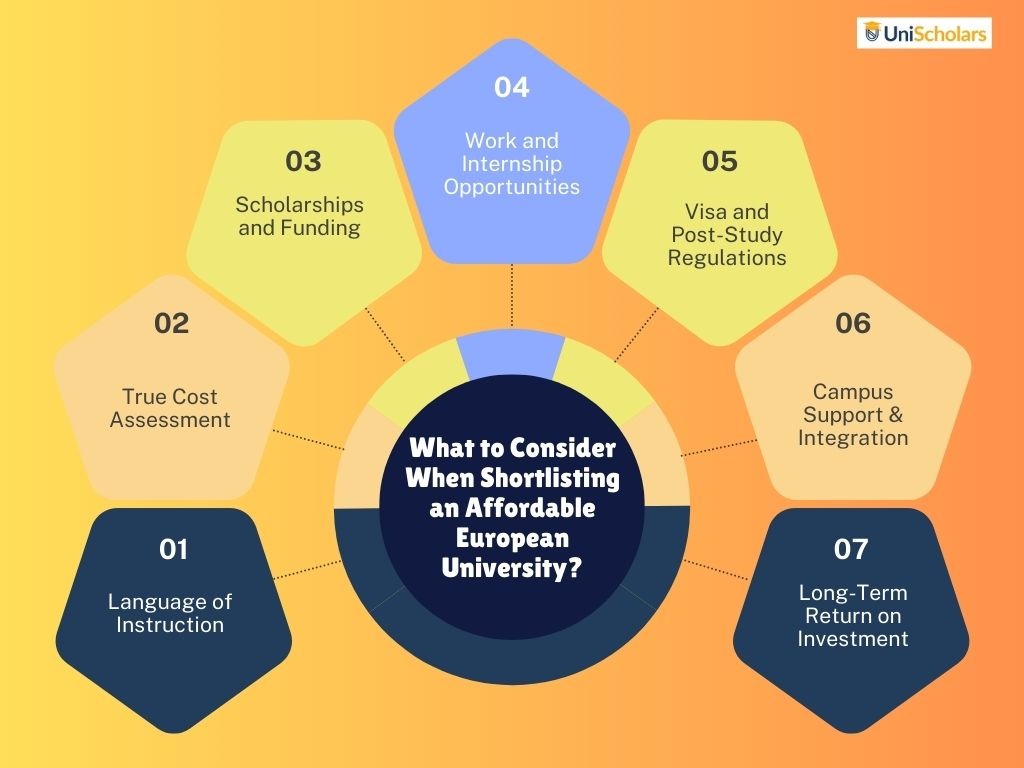
- Language of Instruction: Confirm whether your program is taught in English or the local language, and ensure you meet proficiency requirements (IELTS, TOEFL, TestDaF, DELF, CILS, etc.).
- True Cost Assessment: Compare tuition alongside semester contributions, housing, insurance, and living expenses to calculate the actual cost of studying.
- Scholarships and Funding: Identify merit-based or need-based scholarships, fee waivers, and government-backed support offered to international students in Germany, France, Italy, Austria, and beyond.
- Work and Internship Opportunities: Check part-time job limits, internships, and co-op programs, as they impact both experience and living affordability.
- Visa and Post-Study Regulations: Understand student visa duration, work allowances during study, and post-graduation work permit options for career continuity.
- Campus Support & Integration: Evaluate international student offices, language support, housing services, and mentoring programs to ensure smooth academic and social integration.
- Long-Term Return on Investment: Assess graduate employability, professional networks, Erasmus+ mobility, and the university’s reputation in your chosen field.
Here’s a helpful Quora discussion on the best universities in Europe, where students and graduates share real experiences, preferences, and advice

Common Myths About Cheap Universities in Europe
Myth 1: Cheap Universities Mean Low Quality
Many tuition-free or low-cost European universities in Germany, France, Italy, Austria, and Switzerland rank among the world’s top research institutions. Low fees reflect government policy, not academic standards.
Myth 2: English-Taught Programmes Are Rare
Thousands of programs are available in English. Europe offers more than 2,500 bachelor’s and 8,000 master’s courses in English, particularly in Germany, France, Italy, the Netherlands, Austria, and the Nordic countries. Even elite universities provide full degrees in English.
Myth 3: Graduates Struggle to Find Jobs
Employability is linked to skills and industry demand, not tuition. Many public universities have strong employer connections, and countries such as Germany, France, and Austria offer post-study work permits to graduates.
Myth 4: Scholarships Are Hard to Find
Many funding options exist for international students. DAAD, Erasmus+, Campus France, OeAD, Italian and Swiss government scholarships, and university-specific awards make study affordable. Some top schools like Scuola Normale Superiore and Sant’Anna provide full financial support to all admitted students.
Wrapping Up!
Europe’s most affordable institutions prove that low tuition doesn’t mean low quality. The cheapest universities in Europe for international students combine world-class academics, vibrant research environments, and strong career prospects, all without the hefty price tag of UK or US programs. When evaluating options, consider the full picture: living expenses, language requirements, campus culture, and long-term employability to make Europe an unmatched destination for ambitious learners seeking both excellence and value.
To explore study options, including how to study in France or other leading European countries, UniScholars provides end-to-end guidance, from admissions to scholarships.





1 thought on “Top PGDM Courses In Canada: Universities & Eligibility”
I have done Bachelor’s in Culinary Arts from India and completed my graduation in the year 2022 .I am 22 years old. After graduation, I have done 1 year paid internship from USA .Now, I would like to take occupational experience and learn culinary skills and also do masters in Culinary arts.How can I find the college n best course / country where I can persue studying further