







The United Kingdom remains a top destination for international students, but recent trends show a more structured visa review process. The UK student visa rejection rate has edged up to around 4.75% in 2025, reflecting closer checks on documentation, finances, and academic plans. While these figures might seem daunting, they’re less about rejecting deserving students and more about ensuring applications are complete and clear.
For prospective applicants, understanding the common pitfalls and preparing thoroughly can make all the difference. This blog highlights key reasons for refusals and offers actionable insights to help 2026 applicants put their strongest foot forward.
UK Student Visa Rejection: The Big Picture
| Year | Total Study Visas Issued | Number of Rejections | Rejection Rate |
| 2019 | 404,410 | 15,668 | 3.73% |
| 2020 | 250,121 | 9,354 | 3.60% |
| 2021 | 435,110 | 9,687 | 2.18% |
| 2022 | 623,698 | 11,807 | 1.86% |
| 2023 | 604,253 | 26,308 | 4.17% |
| 2024 | 418,932 | 19,834 | 4.52% |
| 2025 | 389,178 | 19,390 | 4.75% |
Looking at the trend over the past few years, UK study visa rejection rates have changed gradually. After reaching a low of 1.86% in 2022, rejection rates have moved up slightly to around 4–5% between 2023 and 2025. While this shows a rise, it’s important to remember that the vast majority of applicants are still being approved, and the UK continues to welcome international students in large numbers.
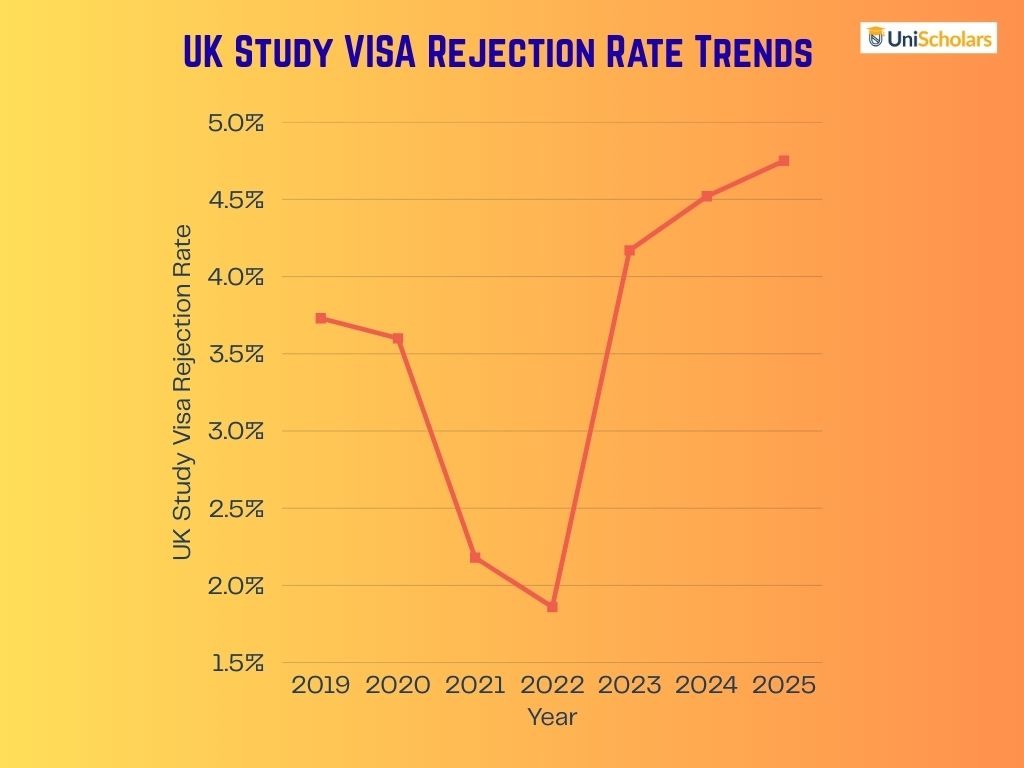
For students applying in 2026, this trend simply highlights the importance of being well-prepared. Applicants with clear documentation, proof of financial stability, and a strong academic purpose typically secure visas without difficulty.
Common Reasons for UK Student Visa Rejection
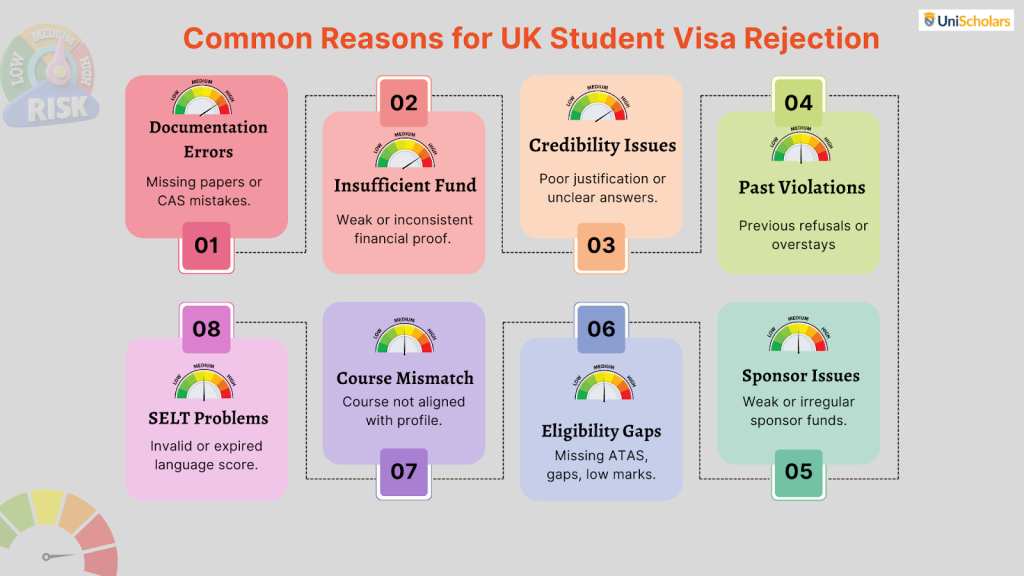
- Incomplete or incorrect documentation
Errors in essential documents such as passports, CAS details, financial proofs, or academic records remain one of the top causes of refusals. A large share of administrative rejections in 2024 and early 2025 were linked to missing pages, mismatched CAS information, or uncertified translations. Even small inconsistencies, such as name spelling differences or wrong course dates, can trigger deeper scrutiny.
- Insufficient funds or weak financial evidence
Financial issues consistently account for a major portion of refusals, with some student categories reporting more than 25 % of rejections tied to incomplete or suspicious financial documents. UKVI checks whether tuition and living cost funds are held for the required 28-day period and whether deposits appear credible. Sudden large transfers without proof of origin, inconsistent balances, or unsupported sponsor claims often lead to rejection.
- Doubts over genuine student intentions
Credibility concerns arise when the applicant’s study plans, academic background, and career goals do not form a logical path. Weak interview responses, unclear reasoning for choosing a course, or selecting programs unrelated to past qualifications increase the risk of refusal. UKVI assesses intent closely, especially after 2024 policy changes, and applicants who appear more interested in work or migration than education face higher rejection rates.
- Previous visa history or immigration violations
Past refusals, overstays, or breaches of immigration conditions negatively affect credibility. Around 5% of refusals in recent years have cited issues tied to visa history or undisclosed immigration actions. UKVI places significant importance on honesty, so failure to declare past refusals results in instant rejection.
- English language or SELT test problems
Incorrect, expired, or invalid English test results often cause rejections. Some applicants submit tests not accepted by UKVI, fail to meet the minimum scores required by their course, or provide documents that do not match university requirements.
Also read: English Language Assessment Test: Why Your Accent Isn’t a Problem
- Course mismatch or unclear academic progression
Applications are frequently questioned when the chosen course does not align with the applicant’s educational history or work experience. Switching fields without a proper explanation, applying for a lower-level qualification after already completing a higher level, or choosing a course unrelated to future goals prompts additional scrutiny.
- Failure to meet UK visa conditions
Rejections also occur when age limits, academic criteria, or gap-year explanations are unclear or unsupported. Older applicants or applicants with long study gaps often face additional questions about intent and academic motivation.
- Sponsor or funding irregularities
Funding issues remain another major cause of refusal. When sponsors have unverifiable income, irregular transactions, or incomplete bank documentation, the application is likely to be rejected.
This Quora discussion also highlights how frequently applicants encounter these issues during the visa process.

UK Visa Process Updates Over the Years
The UK student visa process has seen notable updates in recent years, aimed at ensuring applications are complete and applicants are well-prepared. Key changes include tighter financial requirements, revised English-language verification (SELT), and more precise handling of Confirmation of Acceptance for Studies (CAS) by universities.
These updates have contributed to a slight rise in the UK student visa rejection rate, which moved from under 2% in 2022 to around 4.75% in 2025. Most refusals relate to incomplete forms, insufficient financial documentation, or CAS discrepancies—issues that can be avoided with careful preparation.
While these rules make the process more structured, they are not a barrier for genuine applicants. Understanding and following the updated requirements helps students submit stronger, error-free applications and improves the chances of approval.
UK Student Visa Requirements 2026 (Must-Know Updates for Applicants)
The UK has strengthened several areas of its visa process, and applicants must meet these updated standards clearly and consistently to ensure smoother approval. Understanding the UK student visa requirements for 2026 is essential for avoiding preventable mistakes that can contribute to the uk student visa rejection rate.
- Financial maintenance requirements
Applicants must show proof of funds covering tuition fees plus living costs for at least 28 consecutive days. This includes £1,334 per month if studying in London or £1,023 per month outside London. Any sudden deposits, unclear fund sources, or incomplete financial documents increase the likelihood of refusals and influence the UK student visa rejection rate. Education loans, sponsor bank records, and income proofs must be fully verifiable.
- Confirmation of Acceptance for Studies (CAS) accuracy
CAS details must match the applicant’s passport, academic history, intake, and course information exactly. UKVI checks for consistency across all documents, and even minor errors can lead to delays or refusals. Universities are also subject to stricter Basic Compliance Assessment requirements, making CAS issuance more regulated.
- English language and SELT requirements
Applicants must meet the English language standards set by their university and by UKVI. Only approved SELT providers such as IELTS for UKVI are accepted. Incorrect test types, expired scores, or mismatches between course level and test results remain common issues seen in the uk student visa rejection rate.
Also Read: What IS UKVI IELTS? Know Meaning, Test Scores, Exam Pattern
- Genuine student requirement
Applicants must clearly demonstrate genuine study intent. This includes showing academic progression, a logical connection between previous studies and the UK course, and credible future plans. Strong SOPs, interview preparedness, and supporting documents help reinforce genuine intent.
- Compliance with updated dependent rules
Under the current rules, only students enrolled in research-based postgraduate programmes are eligible to bring dependants. Taught master’s students are not permitted dependents, and misunderstanding this rule can lead to application errors.
- Clean immigration and documentation history
Applicants must fully disclose any past visas, refusals, or immigration actions. UKVI cross-checks all records, and incomplete disclosure can lead to automatic rejection. Accurate, transparent documentation strengthens credibility and compliance.
Also read: Study In The UK Vs New Zealand
UK Student Visa Checklist for International Applicants
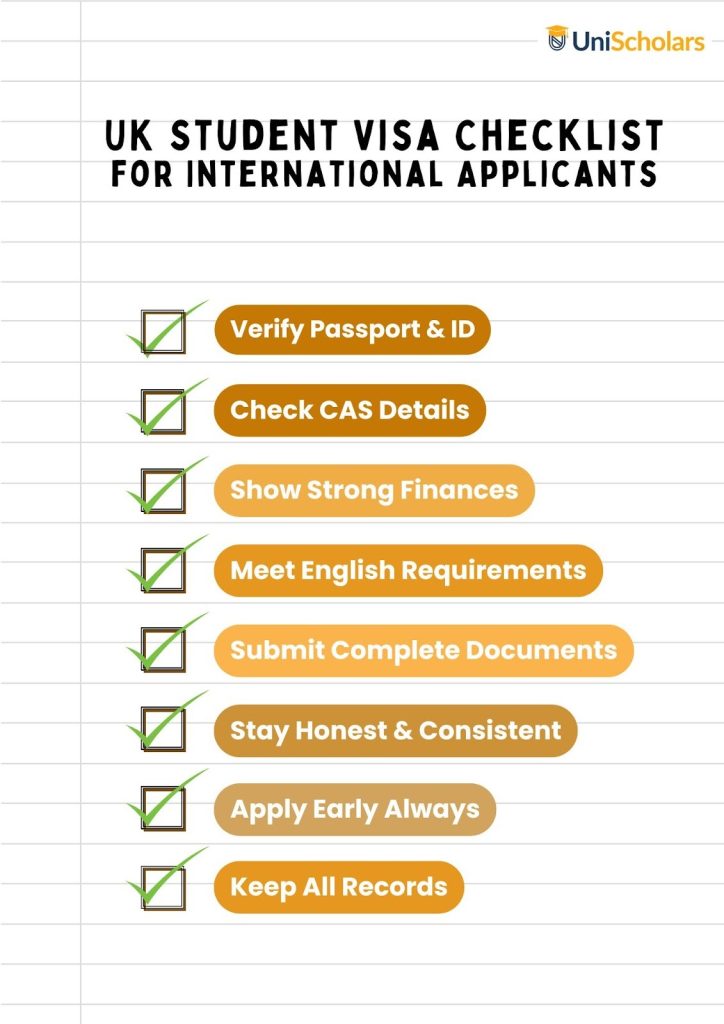
1. Check and verify passport validity and identity documents
Ensure your passport is valid for the full duration required and has multiple blank pages for visa stamping. Verify that all biodata pages, previous visas, and travel stamps are clear, legible, and match your personal details exactly. Even minor inconsistencies in name spellings, dates, or signatures can cause verification delays or doubts about authenticity.
2. Ensure correct CAS and course information
Cross-check your Confirmation of Acceptance for Studies letter line-by-line. Confirm the course title, start and end dates, tuition fees, deposit payments, and university sponsorship details. If your CAS mentions documents assessed for admission, ensure you include them in the visa file. Any mismatch between your CAS and submitted documents can lead to credibility concerns.
3. Show genuine financial capacity with solid evidence
Submit 28-day bank statements that clearly show required tuition and living costs, without unexplained deposits or last-minute fund transfers. If using a sponsor, include an authentic sponsorship letter, proof of financial ability, and relationship evidence where necessary. Make sure currency conversions align with OANDA rates. Financial clarity is essential since inconsistencies form a major portion of the uk student visa rejection rate.
4. Meet English-language or SELT requirements accurately
Provide valid test results from an approved UKVI SELT provider. Ensure the test is still within its validity period and that your personal details on the certificate match your passport exactly. If your university has exempted you from SELT, keep the exemption letter or proof of medium of instruction (MOI) ready, as UKVI may request further clarification.
5. Submit complete and well-organised documentation
Include all required documents: passport, photographs, CAS, fee-payment receipts, academic transcripts, scholarship letters, sponsor proofs, and any additional documents listed under CAS notes. Documents should be organised logically, clearly labelled, and free of omissions. Missing papers often result in automatic refusals.
6. Be truthful and consistent in travel, visa, and background declarations
Disclose all previous visa refusals, immigration issues, and travel history accurately. UKVI cross-checks global databases, and any inconsistency may be interpreted as deception. Transparent disclosure strengthens credibility and reduces the likelihood of being flagged for further background verification.
7. Apply well before deadlines to avoid rushed errors
Start preparing your application weeks in advance to allow time for document corrections, biometric appointments, TB test scheduling, and university updates to your CAS. Early submission reduces the risk of missing documents, unclear financial records, or last-minute mistakes that commonly contribute to the uk student visa rejection rate.
8. Keep copies and digital records of all submissions
Save scanned versions of every document you submit, including receipts, statements, forms, and confirmation emails. These records help you respond quickly if UKVI requests additional evidence and act as proof if there are processing errors or discrepancies later.
Also read: Motivation Letter Template: How to Write for University Applications
Facing a refusal can feel overwhelming, but a clear and strategic response can significantly improve your chances the second time around. With the UK student visa rejection rate showing consistent scrutiny in areas like finances and documentation, the steps below help you act methodically.
Whether you’re choosing the right university, exploring scholarships, or preparing for applications — UniScholars provides expert guidance every step of the way. Start your global education journey with confidence.
🌍 Explore Study Abroad ServicesWhat to Do If Your UK Student Visa Is Rejected?
- Understand the Refusal Letter Completely
Read the UKVI refusal letter line-by-line to identify the exact reason for rejection. Note whether the issue relates to finances, CAS errors, credibility, or missing documents, as this determines whether you should appeal or reapply. Keeping a copy of the letter is essential for any future application or review.
- Appeal the Decision if UKVI Made an Error
You may request an Administrative Review (AR) if you believe UKVI misapplied the rules or misunderstood your documents. AR does not allow new evidence, so only choose this if the refusal is clearly based on caseworker error. The review has a small fee and strict timelines, usually 14 to 28 days, depending on your location.
- Reapply With Corrected and Stronger Documents
If the refusal stems from financial inconsistencies, CAS mismatches, incomplete documents, or credibility concerns, a fresh application is usually the best option. Strengthen every weak area: correct CAS details, improve financial evidence, add clearer study intentions, and ensure full transparency. Reapplications often succeed when issues are fixed thoroughly.
- Consider Deferring Your Admission
If timelines are tight or documentation needs time to rebuild (e.g., 28-day financial history), request a university deferral. Deferring protects your offer, gives time to prepare stronger documents, and avoids rushed mistakes that contribute to the uk student visa rejection rate.
- Explore Alternative Programmes or Institutions
If your course or university raises credibility concerns, consider switching to a programme better aligned with your academic or career history. Choosing a course that fits your profile more naturally can strengthen your narrative and reduce the likelihood of repeated refusals.
- Plan a Productive Gap Year if Needed
If immediate reapplication isn’t feasible, use a gap year to build academic skills, gain work experience, complete language tests, or rewrite your statement of purpose. A well-utilised gap year can help present a stronger, more credible profile in your next application.
- Calculate Timelines and Hidden Costs
Factor in visa fees, priority processing charges, CAS deposit payments, and the cost of medical tests or document translations. Rejections often lead to additional expenses like flight cancellations or housing losses. Planning ahead helps reduce stress and prevents rushed decisions.
- Prepare Emotionally and Financially
A refusal can be discouraging, but remember it is not the final outcome. Strengthen your support system, plan finances carefully, and use checklists to avoid repeating errors. Many applicants succeed after one or two attempts once weaknesses are fixed.
Conclusion
A clear path opens up when you understand what the UK is actually checking for. Most dips in the UK student visa rejection rate come down to avoidable gaps like unclear finances, CAS inconsistencies, or documents that don’t fully meet the criteria. When every piece of your application aligns, the process feels far less unpredictable.
Setbacks happen, but they’re fixable. If you’re aiming to study in the UK, UniScholars offers guidance to pinpoint issues and strengthen your next visa submission. You get structured CAS guidance, meticulous document reviews, financial clarity checks, and interview preparation designed to eliminate the usual slip-ups. The goal isn’t just to apply; it’s to submit an application that stands strong even under closer scrutiny.







1 thought on “Top PGDM Courses In Canada: Universities & Eligibility”
I have done Bachelor’s in Culinary Arts from India and completed my graduation in the year 2022 .I am 22 years old. After graduation, I have done 1 year paid internship from USA .Now, I would like to take occupational experience and learn culinary skills and also do masters in Culinary arts.How can I find the college n best course / country where I can persue studying further