






One missing document is all it takes for a strong UK application to stall, and English proof is often where it happens. UK visas rely on SELT Exams to confirm academic readiness, making them non-negotiable for most student routes. In the year ending June 2024, 432,225 sponsored study visas were granted, yet many refusals traced back to unmet language criteria. SELT Exams assess reading, writing, speaking, and listening through approved providers.
This blog breaks down who needs an SELT, accepted tests, CEFR levels, fees, booking, and what to prepare, before a technicality costs you an offer.
An Overview of SELT Exams
| SELT Exam | Provider | Suited For | Skills Tested | Validity |
| IELTS for UKVI (Academic / General) | IELTS SELT Consortium | Student visas and most UKVI routes needing full language proof | ReadingWritingListeningSpeaking | 2 years |
| PTE Academic UKVI | Pearson | Students preferring a fully computer-based test | ReadingWritingListeningSpeaking | 2 years |
| Skills for English UKVI | PSI Services | Family, work, and select student routes (level-based) | Speaking & Listening or all 4 skills | 2 years |
| Trinity College London (GESE / ISE) | Trinity College London | Visas needing face-to-face assessment | GESE: Speaking & listening ISE: All 4 skills | 2 years |
SELT exams can feel overwhelming, but they are just the starting point to study in the UK. UniScholars helps you connect English test requirements with the right universities and courses, making your path from eligibility to enrolment clear and confident.
🌍 Explore SELT Guidance ServicesUnderstanding the SELT exams
SELT exams, or Secure English Language Tests, are UK Home Office-approved English proficiency tests used to meet language requirements for UK visa and immigration purposes. Only tests taken with approved providers at authorised centres are recognised. SELTs assess English ability against CEFR levels and may test either speaking and listening only or all four skills, depending on the specific UKVI requirement.
Why do UK Visas and Universities Mandate SELT?
- Academic Readiness: UK universities use SELT exams to confirm that students can function in an English-only academic environment. The required CEFR level ensures you can follow lectures, contribute to discussions, complete written work, and sit assessments without language becoming a barrier to performance.
- Immigration Compliance: UK Visas and Immigration mandates SELT exams to verify genuine English ability for students and other visa routes. Tests are accepted only from approved providers under controlled conditions, ensuring consistency, security, and credibility across applications.
- Visa Accuracy and Approval: Incorrect or non-approved English evidence is a frequent cause of UK student visa rejection. SELT results are securely linked to applications and remain valid for two years, helping applicants avoid delays, rejections, and repeat costs.
- Everyday Integration: Beyond admissions and visas, SELT requirements ensure students can communicate confidently in daily life, from university interactions to housing, healthcare, and part-time work. Since requirements vary by visa route and can change, checking the latest UKVI guidelines before booking is essential.
Recent Law Changes and Updates to the SELT Exam
From 1 January 2025, LANGUAGECERT has withdrawn the ESOL SELT four-skills test and introduced two new options approved for UKVI routes:
- LANGUAGECERT Academic SELT
- LANGUAGECERT General SELT
Results from the discontinued ESOL SELT remain valid for two years from the award date, and unused vouchers can still be redeemed within twelve months of purchase. As approved tests and visa requirements may change, applicants must verify the current SELT list on the official gov.uk website before booking.
Curious why UK universities insist on IELTS for UKVI? A popular Quora discussion unpacks the real reasons behind this requirement, sharing firsthand experiences and clear explanations that make the rules easier to understand.

Who Needs a SELT?
- Student Visa Applicants
Most international students must submit a UKVI-approved four-skills SELT, such as IELTS for UKVI Academic, to meet Student route requirements. Universities typically align this with CEFR B2, ensuring you can follow lectures, write assessments, and participate in academic discussions. An incorrect or missing SELT can delay or invalidate both your visa and admission.
- Skilled Workers and Health Professionals
Applicants under these routes must prove workplace-ready English, usually at CEFR B1 across all four skills. UKVI uses SELT results to confirm effective communication, professional safety, and on-the-job integration.
- Family and Settlement Routes
Partners, parents, and settlement applicants often need speaking and listening-only SELTs, such as Trinity GESE, at A1 to B2, depending on the visa category. The test level must match the route exactly.
- Innovators and Start-up Founders
Entrepreneurs are generally required to submit a four-skills SELT at B2, demonstrating the ability to present, operate, and scale a business in English under UKVI standards.
SELT vs IELTS vs TOEFL
| Aspect | SELT (UKVI-approved tests) | IELTS (Standard / Academic) | TOEFL iBT |
| UKVI visa acceptance | Mandatory for UK visas (Student, Skilled Worker, Family, Settlement) | Not accepted for UK visas | Not accepted for UK visas |
| Who approves it | UK Home Office (specific SELT versions only) | Test provider / universities | ETS / universities |
| Test centres | Only at UKVI-approved centres | Any official IELTS centre | Any official TOEFL centre |
| Security & verification | High-security testing with SELT reference number directly verified by UKVI | Standard security, no UKVI verification | Standard security, no UKVI verification |
| Skills tested | Route-specific: 4 skills or speaking & listening only | 4 skills only | 4 skills only |
| CEFR alignment | Explicitly mapped to A1–C2 for visa routes | CEFR mapped for admissions | CEFR mapped for admissions |
| Validity for visas | Valid for 2 years (UKVI-linked) | Invalid for UK visas | Invalid for UK visas |
| Use case | UK visa + university (when required) | University admissions only | University admissions only |
| Result submission | Digital verification by UKVI (no uploads needed) | Manual TRF submission | Manual score report submission |
So, if a UK visa is involved, only SELT exams count. Standard IELTS and TOEFL scores are accepted for university admissions but do not meet immigration requirements.
Types of SELT Exams for UK Visas & University Applications
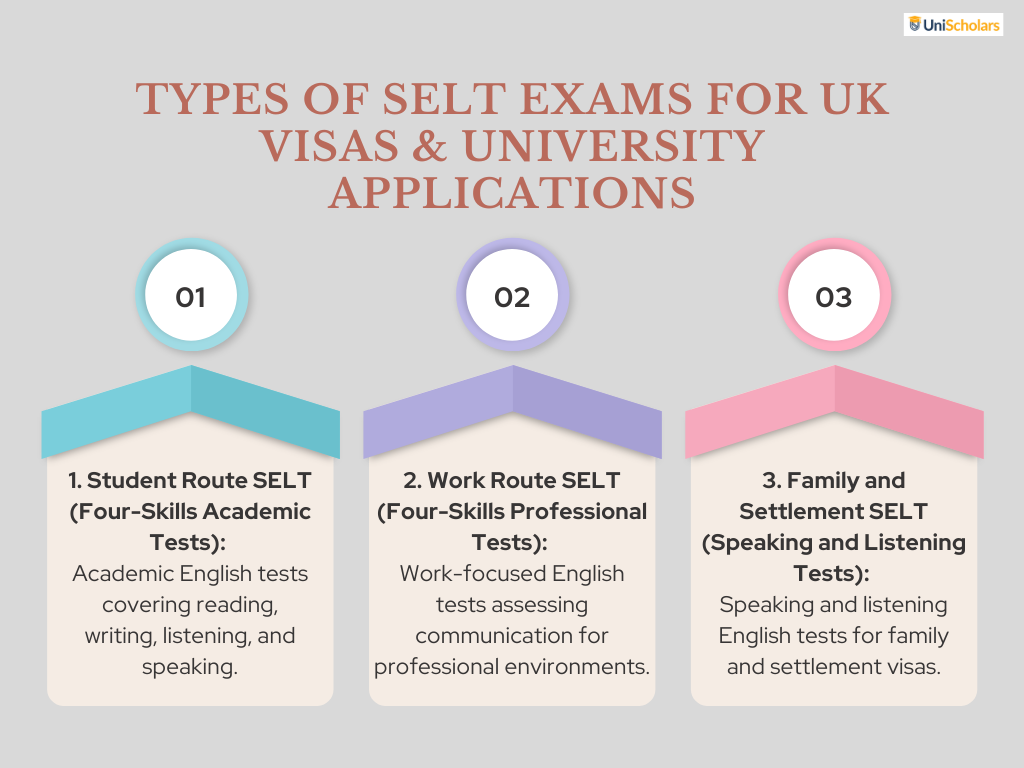
1. SELT for UK Student Visa (Student Route)
This is a UKVI-approved SELT required for Student visa applications and many UK university admissions.
| Who needs it? | International students applying for undergraduate or postgraduate courses in the UK who are non-native English speakers. |
| Skills tested | Reading, writing, listening, and speaking (four-skills test). |
| Minimum level required | Usually CEFR B2 or higher, depending on the course and university. |
| Common approved tests | IELTS for UKVI Academic, Pearson PTE Academic UKVI, Skills for English (PSI) four-skills SELT. |
2. SELT for Work Visas (Skilled Worker, Health and Care Worker)
This type of SELT is used to meet UKVI English requirements for employment-based visa routes.
| Who needs it? | Applicants applying for Skilled Worker or Health and Care Worker visas. |
| Skills tested | Reading, writing, listening, and speaking (four-skills test). |
| Minimum level required | Typically CEFR B1, unless the role specifies a higher level. |
| Common approved tests | IELTS for UKVI, PTE Academic UKVI, other Home Office-approved four-skills SELTs. |
3. SELT for Settlement, Citizenship and Family Visas
This SELT is designed to prove basic or intermediate English for family life or long-term residence in the UK.
| Who needs it? | Partners, parents, settlement applicants, and those applying for British citizenship. |
| Skills tested | Speaking and listening only (most routes). |
| Minimum level required | CEFR A1, A2, or B1, depending on the visa stage. |
| Common approved tests | Trinity College London GESE (Grades 2–5), Skills for English speaking and listening SELTs. |
Also Read: Top Universities in the UK for 2026: Your Ultimate Guide!
SELT Tests by Providers
| Provider | CEFR Levels & Skills | Price (INR) | Result Speed | Ideal For |
| IELTS for UKVI | Life Skills A1/B1: Speaking & ListeningAcademic/ General: 4 skills | Life Skills: 16,050Academic/General: 17,250 | Computer: 1–5 daysPaper: up to 13 days | Students & workers needing a widely recognised four-skills SELT |
| PTE Academic UKVI | B1–C1: 4 skills (study/work)Home A1–B1: Speaking & Listening | Academic: 18,000Home: 15,284 | 2–5 days | Applicants preferring computer-based SELT with fast results |
| Trinity SELT | GESE A1–B1: Speaking & ListeningISE B1–C1: 4 skills | GESE: 18,000ISE: 21,000 | GESE provisional: next dayISE: 4–7 days | Family/settlement visas; select study or work visas |
| Skills for English | A1–A2: S&L onlyB1–C2: S&L or 4 skills depending on route | 4 skills: 15,900S&L: 13,400 | 3–5 days | Flexible SELT options for study, work, or family visas |
SELT Exam Format Breakdown
| Exam | Test Type | Modules | Duration | Visa Routes |
| IELTS for UKVI | Academic/ General | Listening, Reading, Writing, Speaking | 2h 41–45m | Student, Skilled Worker, study/work |
| IELTS Life Skills | Speaking & Listening only | Speaking & Listening | A1:16–18m, A2:20m, B1:22m | Family, settlement, citizenship |
| PTE Academic UKVI | 4 skills | Speaking & Writing, Reading, Listening | 2h | Student, Skilled Worker, study/work |
| PTE Home | Speaking & Listening only | Speaking & Listening | 20–25m | Family, settlement, citizenship |
| Trinity ISE I–III | 4 skills | Reading, Writing, Speaking, Listening | ISE I:22m, II:25m, III:30m | Student, work, settlement |
| Trinity GESE (Gr2–5) | Speaking & Listening only | Speaking & Listening | 6–10m | Family visas, settlement |
| Skills for English (4-skills) | 4 skills | Reading, Writing, Speaking, Listening | B1:175m, B2:190m | Tier 2, Health & Care (B1), Innovator/Start-up, Student (B2) |
| Skills for English (S&L) | Speaking & Listening only | Speaking & Listening | A1:30m, A2:35m, B1:50m | Family, settlement |
SELT Requirements for UK Universities
- UKVI-Approved Tests Only
UK universities sponsoring international students require SELT exams approved by UK Visas and Immigration. Tests must be taken at authorised centres listed on gov.uk. Accepted exams include IELTS for UKVI, Trinity College London SELT, PTE Academic UKVI, and Skills for English UKVI. Your result must be valid at the time of both visa application and university admission.
- Matching CEFR Levels to Course Requirements
Universities set English requirements based on course level and subject, usually aligned with the CEFR. Degree programmes typically require at least B2 in all four skills, but confirm your course-specific level in your offer letter or admissions page.
- SELT Validity Period
Results are valid for two years from the test date. Applications and CAS issuance require SELT results within this period to avoid delays or rejections.
- Separate Entry Requirement from Visa Requirement
Meeting the minimum UKVI SELT standard does not guarantee university admission, and vice versa. Some courses, especially language-intensive or competitive programmes, may set higher benchmarks. Check both early to avoid last-minute issues.
- Alternative Proof and Exemptions
Some universities accept prior English-medium education or internal assessments as partial proof, but these rarely substitute for an approved SELT for visa purposes. Always confirm exemptions with your university’s admissions office.
Also read: Your Guide On The Education System In The UK
How to Choose the Right SELT Exam?
- Visa Category
Your visa route dictates the SELT you need. Student visas generally require a four-skills test, such as IELTS for UKVI Academic, at B2, while family visas often accept speaking and listening tests, such as Trinity GESE, at A1/A2. Always confirm your route, Student, Skilled Worker, or Partner, against the official gov.uk-approved test list to avoid delays or retakes.
- Score Requirements
Universities may set higher English requirements than those set by UKVI. For instance, an undergraduate course may require B2 with minimum scores in each skill (e.g., overall IELTS 5.5+). Computer-based tests like PTE Academic UKVI provide clear CEFR mapping. Cross-check your offer letter with the provider’s official score guide.
- Test Centre Availability
Centre access varies, particularly in India. PTE Academic UKVI and Skills for English often provide wider coverage. Book 4–6 weeks in advance during peak periods and use only official gov.uk-listed centres.
- Result Turnaround Time
Fast results can be critical for CAS deadlines. PTE Academic UKVI is delivered in 2 days; IELTS paper tests take approximately 13 days; and Trinity GESE often provides next-day results. Choose based on timing needs.
- University-Specific Acceptance
Not all UKVI-approved SELTs are accepted by every university. Russell Group universities may require IELTS for UKVI Academic and reject alternatives. Always verify the institution’s accepted tests.
- Budget Considerations
Fees differ by test type. Skills for English four-skills tests are often cheaper than IELTS for UKVI. Family visa speaking/listening tests like Trinity GESE are usually lower cost. Include retest and travel costs in your calculations.
Step-by-Step Application Process for SELT Exams
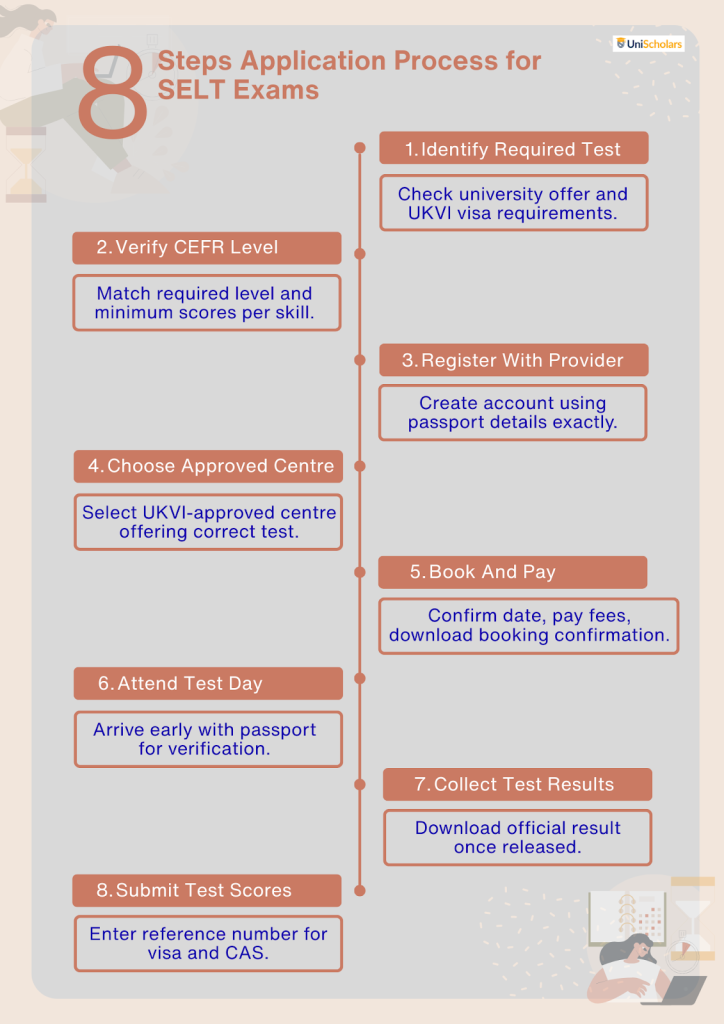
1. Confirm which test you need
Start by checking your university offer and the Student visa requirements on the official gov.uk website. Degree-level courses usually require a four-skills SELT such as IELTS for UKVI Academic or PTE Academic UKVI. Speaking- and listening-only tests, such as Trinity GESE, are generally used for family or settlement routes, not for degree programmes. Choosing the wrong test can result in delays, retakes, and additional costs.
2. Check CEFR level requirements
Your offer letter will clearly state the required CEFR level, such as B2 for most undergraduate programmes or C1 for competitive postgraduate courses. Universities often specify minimum scores in each skill, not just an overall score. Use the official score comparison charts from the test provider to confirm that your target score meets both university and visa requirements.
3. Create an account with the chosen provider
Register directly on the official test provider website, such as the British Council for IELTS for UKVI or Pearson for PTE Academic UKVI. Enter your passport details exactly as they appear on your document to avoid identity issues on test day. Most providers require you to upload a passport scan during registration. Once verified, you can view available test dates and centres.
4. Select a UKVI-approved test centre
Choose a test centre listed on the gov.uk approved SELT centres page to ensure your result is valid for visa purposes. Confirm that the centre offers the correct test type, such as Academic or Life Skills, before booking. During peak application periods, it is advisable to book four to six weeks in advance to secure a convenient date and location.
5. Book the exam and pay the fees
Select a test date that fits your application timeline and complete payment through the provider’s secure booking portal. After booking, download and print your confirmation details. Ensure the name on your booking exactly matches the name on your passport, as discrepancies can cause issues on test day. Avoid booking through unofficial agents, as UKVI only recognises tests booked directly with approved providers.
6. Attend the test
Arrive early at the test centre with your original passport for identity and biometric checks. UKVI-approved centres follow strict security procedures, including photographs and fingerprint verification. Personal belongings are not allowed in the test room, and test conditions are closely monitored.
7. Receive your results
Result timelines vary by provider and test format. PTE Academic UKVI typically releases results within two days, while IELTS for UKVI results are available within a few days, depending on whether the test is computer-based or paper-based. Trinity GESE results are often issued quickly for family visa routes. Always download or collect your official result document as soon as it is available.
8. Submit scores for your visa and university application
Enter your SELT reference number directly in your Student visa application, allowing UKVI to verify your result electronically. Share your test result with your university admissions team so they can confirm your CAS. Keep original documents safely, as you may be asked to present them later.
Tips to Prepare for SELT Exams Efficiently
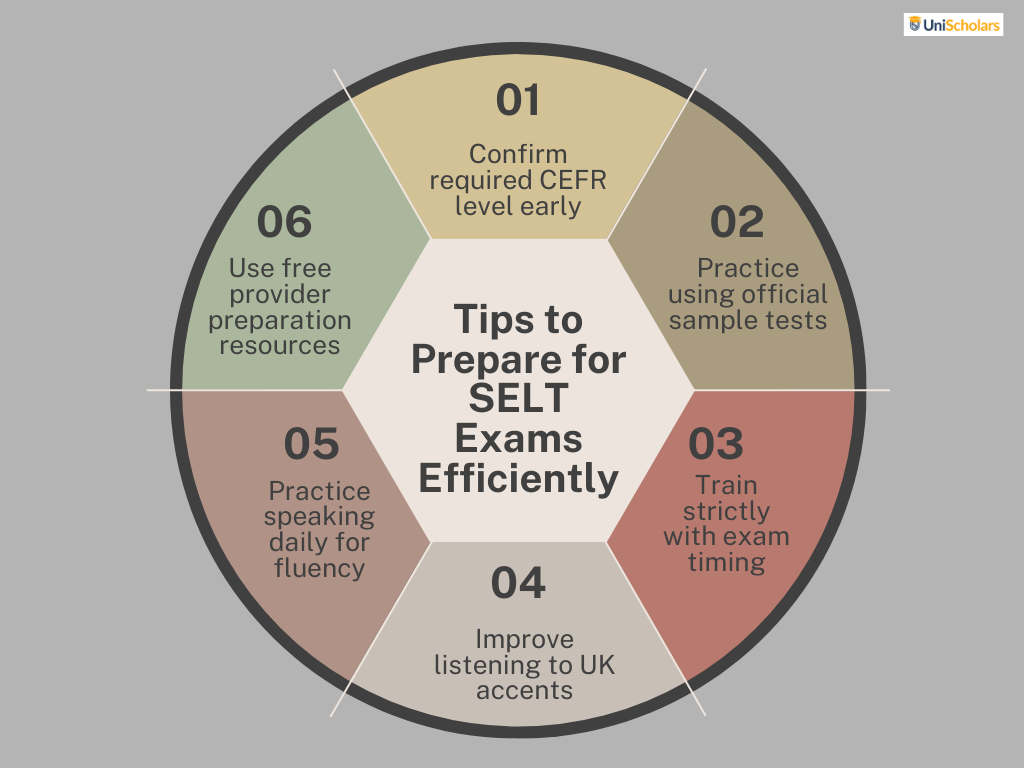
- Confirm Your CEFR Level
Check your CAS or university offer to know the exact CEFR level needed. Most undergraduate courses require B2, some postgraduates C1. Compare current practice scores with official conversion charts and focus on weaker skills rather than over-studying.
- Use Official Practice Tests
Rely on materials from your test provider. IELTS for UKVI: timed reading and writing tasks; PTE Academic UKVI: computer-based mocks. Full-length practice familiarises you with question types and reduces test-day stress. Review band descriptors after each attempt.
- Master Time Management
Train under exam conditions. Skim and scan reading passages efficiently, track your timing, and ensure you can complete every section comfortably.
- Enhance Listening Skills
Listen to official samples, including UK accents, lectures, and conversations. Replay recordings at slightly faster speeds, note numbers, dates, and key points, and aim to exceed minimum scores consistently.
- Daily Speaking Practice
Record responses to common prompts, review clarity and fluency, and practise short talks on familiar topics. Peer or tutor feedback helps correct pronunciation and coherence issues.
- Leverage Free Provider Tools
Use webinars, video lessons, and practice questions offered by approved test providers. Align resources with your specific SELT exam and CEFR level to understand marking criteria and avoid common mistakes.
Preparing for SELT exams becomes easier with the right strategy and expert support. UniScholars offers practical IELTS preparation guidance that helps you strengthen key skills, manage time effectively, and approach your English test with confidence.
🌍 Explore IELTS Preparation TipsConclusion
Mastering SELT Exams can make the difference between a seamless UK visa process and unnecessary delays. Selecting the right test for your visa route, CEFR level, and approved provider ensures your English proficiency is recognised without complications. Early preparation, targeted practice, and awareness of course-specific requirements turn potential hurdles into clear milestones.
With UniScholars’ expert guidance on test selection, centre booking, and scoring strategies, you can approach SELT Exams confidently and secure both your visa and university admission with ease.








1 thought on “Top PGDM Courses In Canada: Universities & Eligibility”
I have done Bachelor’s in Culinary Arts from India and completed my graduation in the year 2022 .I am 22 years old. After graduation, I have done 1 year paid internship from USA .Now, I would like to take occupational experience and learn culinary skills and also do masters in Culinary arts.How can I find the college n best course / country where I can persue studying further