






Ever binge-watched MasterChef and thought, “Yeah… that apron should have my name on it”? You’re definitely not the only one. Food culture is having a global main-character moment, and the hospitality world is growing fast. That’s why more students are choosing to study culinary arts abroad, to get real kitchen grind, international exposure, and careers that actually travel with you.
But here’s the real question: which culinary school is actually worth your time, money, and effort? In this blog, we break down the 10 best culinary schools in the world, the fees, courses, specialisations, entry requirements, and what makes each school the place to level up your chef dreams from first chop to Michelin goals.
Top Culinary Schools Across The Globe: Quick Comparison
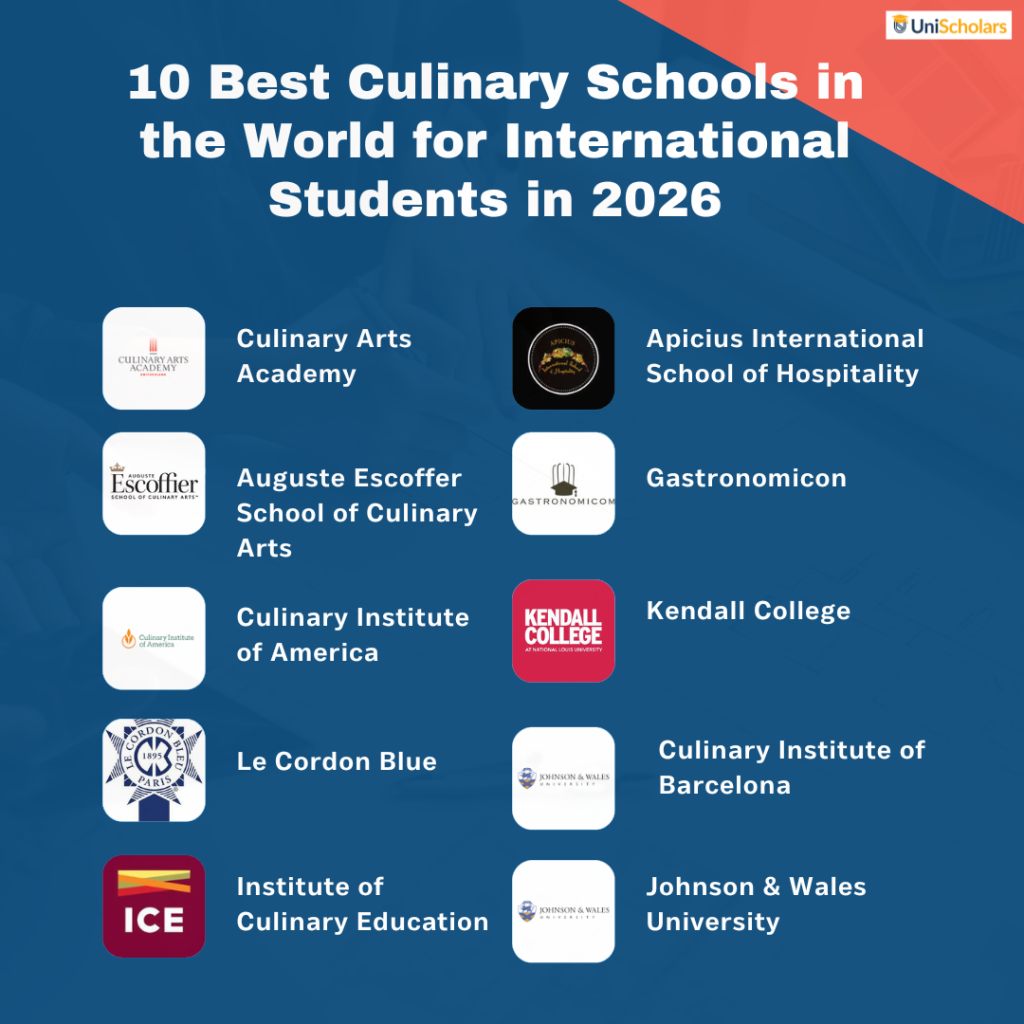
| School | Country | Type of Programs Offered | Avg Tuition Fee | USPs |
| Culinary Arts Academy Switzerland | Switzerland | BA in Culinary ArtsMA in Culinary Business ManagementSwiss Diploma in Pastry ArtsSwiss Diploma in Culinary Arts | UG: CHF 171,100PG: CHF 47,800 | Small classes with hands-on training.Learn from expert chefs in professional kitchens. |
| Auguste Escoffier School of Culinary Arts | USA | Diploma in Culinary Arts & OperationsAssociate Degree in Culinary ArtsDiploma in Professional Pastry ArtsDiploma in Food Entrepreneurship | Diploma: $23,272Associate: $35,145 | Flexible online options for internationals.Strong farm-to-table focus. |
| Culinary Institute of America | USA | Bachelor’s in Food Business ManagementBachelor’s in Applied Food StudiesBachelor’s in Culinary ScienceMaster’s in Food BusinessMaster’s in Culinary Arts | Associate: $22,105/semesterPG: $24,330 | Global internships.Strong international alumni network. |
| Le Cordon Bleu | France | CuisineCulinary & Hospitality ManagementCuisines of the WorldPastry & Confectionery | UG only: €19,800 | Classic French training by expert chefs.Study across global campuses. |
| Institute of Culinary Education | USA | Culinary ArtsBaking & PastryRestaurant & Culinary Management | Diploma: from $16,500Degree: from $31,500 | Short, job-focused courses.Small classes with real kitchen exposure. |
| Apicius International School of Hospitality | Italy | Food & Wine StudiesHospitality StudiesSports & Health Sciences | $19,000 (1-year elective) | Learn with Italian culture immersion.Located in Florence with food labs. |
| Gastronomicon | France | 2–12-month courses in Cooking, Pastry & French. Internship included in select programs | €1,500 – €18,700 | Short-term intensive programs.Includes internships and language learning. |
| Kendall College | USA | Culinary ManagementBaking & PastryHospitality Management | $1,650 – $16,664 | Student-run restaurants for real experience. Strong global career outcomes. |
| Culinary Institute of Barcelona | Spain | Culinary ArtsPastry & BakingManagement courses | Diploma: €17,427Specialised: ~€9,075Haute Cuisine: from €26,620 | Focus on creativity and personal style. Supportive alumni network. |
| Johnson & Wales University | USA | Culinary ArtsCulinary & Food Service ManagementCulinary Nutrition,Master’s in Food Innovation,Food Safety & Hospitality | USD 13,268 – 45,408 | Strong practical learning model. Career-focused, industry-ready courses. |
Explore thisQuora thread where people are sharing their picks for the best culinary schools worldwide, based on reputation, courses, and where alumni end up working.

Key Factors that Define a Good Culinary School
1. Global Recognition
You can think of Accreditation as a blue tick on Instagram. If your culinary school is recognised by the American Culinary Foundation in the United States or global bodies like the World Association of Chefs’ Societies, that means it’s legit. These organisations check whether schools meet quality standards. They do so by reviewing courses, teaching staff, and your performance as a student after completing their studies.
2. Quality of Curriculum
If you start with pastry before learning the basics, it can be tough. A good course teaches skills step by step, from beginner to advanced, so you always know what you’re learning and how it helps your career. The best programs start with core skills and build from there, giving you a clear path forward.
3. Practical Training
Would you rather learn to drive in a real car or on a simulator? Real experience always comes first. The best culinary schools use the latest equipment, like sous vide machines and blast chillers, so when you start an internship, you’re already familiar with the tools. That confidence is built in you when you study at one of the best culinary schools in the world.
4. Alumni Network and Referrals
Honestly, we all low-key stalk our classmates to see where they ended up career-wise. You should do the same when looking at culinary schools. See where their graduates work and how active the alumni network is. A strong alumni group can connect you with professionals, help you find internships, and even offer referrals when jobs open up.
5. Flexible start for International Students
If a culinary school offers flexible start dates, that’s a major green flag. It’s something you should consider when looking at the best culinary schools in the world. As an international student, it’s important to see how well a school supports students from other countries. Look for schools that offer flexible start dates, help with visas, and have strong support teams. Moving to a new country can be tough, so schools that help you settle in and adjust make things much easier. That’s why many students choose top culinary schools that truly support them.
Explore scholarships for culinary programmes on UniScholars and get funding support to kick-start your chef journey at top institutions worldwide.
Explore Culinary Scholarships10 Best Culinary Schools in the World
1. Culinary Arts Academy Switzerland
You’re studying on the shores of Lake Geneva in a former grand hotel, which is basically like living in a luxury resort, so it sounds like a win-win situation. The academy has been around the 1991, and has marched on from Luzernerhof Hotel School into a global achiever, all while maintaining itself among the top 10 worldwide for hospitality education. Here’s what makes it even cooler: you get a perfect balance of tradition and hustle, while you’ll master the legendary Swiss standards of classical cooking.
Program Highlights
| Category | Details |
| Specialisations | Swiss Diploma, Bachelor of Arts, Master of Arts |
| Program Duration | 9–12 months, 3 years, 1 year |
| Average Annual Tuition Fees | CHF 41,200, CHF 57,033, CHF 47,800 |
2. Auguste Escoffier School of Culinary Arts
A big flex for Auguste Escoffier School of Culinary Arts is that it’s a member of Worldchefs. Making history once again by being the first to hold out fully accredited 100% online culinary programmes. Inspired by the OG architect of fine dining, Auguste Escoffier, students learn the iconic Brigade System that’s still used in top kitchens around the world. Since 2010, the school has blended French techniques with career-focused, hands-on learning.
Program Highlights
| Category | Details |
| Specialisations | Diploma in Culinary Arts & Operations, Associate Degree in Culinary Arts, Diploma in Professional Pastry Arts, Diploma in Food Entrepreneurship |
| Program Duration | 8-12 months, 2 years, |
| Average Annual Tuition Fees | Diploma: $23,272 · Associate: $35,145 |
3. Culinary Institute of America
If you’ve seen Netflix’s Next Gen Chef, you’ve already seen the vibe. That’s the Culinary Institute of America, globally recognised for its culinary education, founded in 1946. They have their iconic main campus at Hyde Park, New York. Some specialist centres in California, Texas and Singapore. You still have yet to read the coolest part, why you should study here, every dorm has a full-sized kitchen. Off-campus adventures and friendly campus cook-offs are just a few ways it prepares you to become a next-gen food industry leader.
Program Highlights
| Category | Details |
| Specialisations | Bachelor’s in Food Business Management, Applied Food Studies, Culinary Science; Master’s in Food Business, Culinary Arts |
| Program Duration | Associate: 2 years, Bachelor’s: 4 years, Master’s: 1–2 years |
| Average Annual Tuition Fees | Associate: $22,105/semester · PG: $24,330 |
4. Le Cordon Bleu
You know who brought French culinary training into the spotlight? Le Cordon Bleu. It got featured in famous films and books, including Julie & Julia. So you know, studying here is definitely going to be iconic. Learn from MasterChefs of Le Cordon Bleu who have not just received the Michelin stars but also been winners of competitions and titles like Meilleur Ouvrier de France. They also have campuses in 20 countries and have been in the food industry since 1895.
Program Highlight
| Category | Details |
| Specialisations | Culinary Arts, Hospitality Management, Cuisines of the World, Pastry & Confectionery |
| Program Duration | Undergraduate programmes: 3 years |
| Average Annual Tuition Fees | €19800 |
5. Institute of Culinary Education
As an aspiring chef, have you dreamt of having your food articles and recipes featured in The New York Times, the LA Times, and Food & Wine’s website? That’s the vibe the Institute of Culinary Education brings to the table. By featuring their graduates in these articles and magazines, they focus on giving you the best real-time exposure to succeed as a Chef. Their 20,000 graduates worldwide are a testament to their dedication and honour.
Program Highlights
| Category | Details |
| Specialisations | Culinary Arts, Baking & Pastry, Restaurant & Culinary Management |
| Program Duration | Diploma programmes: 6–12 months, Degree programmes: 2–4 years |
| Average Annual Tuition Fees | Diploma: from $16,500 · Degree: from $31,500 |
Check out this video to see how Le Cordon Bleu London blends hands-on culinary training with modern facilities and the energy of London’s food scene
6. Apicius International School of Hospitality
The moment someone says “Italy”, our brain goes straight to pizza, pasta, tiramisu, and yeah, now lunch plans are ruined. But imagine actually learning to make all of that in Italy itself. Since 1997, as Italy’s first international hospitality school, this place lets you dive deep into Italian food culture while building real hospitality skills that actually matter in the industry. And it gets better. You don’t just train in classrooms, you work in community-based labs like the Ganzo School Restaurant and Fedora Pastry Shop.
Program Highlights
| Category | Details |
| Specialisations | Food & Wine Studies, Hospitality Studies, Sports & Health Sciences |
| Program Duration | Elective programmes: 1 year |
| Average Annual Tuition Fees | $19,000 |
7. Gastronomicon
Did you know the “light of the South” inspired artists like Van Gogh? The vibes here must be immaculate. As a vast sun-drenched region, it’s a perfect place for you to master French cooking. Gastronomicon is known for welcoming nature towards international students. Since 2004, the campus has been modern and bright, located in the beautiful town of Agde, near the Mediterranean coast. You basically get to live in a stunning holiday destination while building your career.
Program Highlights
| Category | Details |
| Specialisations | Cooking, Pastry, French Cuisine (internships included in select programmes) |
| Program Duration | Short-term intensive courses: 2–12 months |
| Average Annual Tuition Fees | €1,500 – €18,700 |
8. Kendall College
You might’ve already seen this place on Season 2 of The Bear, yep, the scenes where characters actually enrol in real culinary classes? That’s Kendall College getting its pop-culture moment. On campus, students literally run a public restaurant called The Dining Room, which is Michelin-recommended. So you’re not just practising, you’re handling real guests, real pressure, real service, from the kitchen all the way to the floor. Founded back in 1934 and officially becoming a culinary school in 1985, Kendall’s taken a slightly unconventional route, but it works.
Program Highlights
| Category | Details |
| Specialisations | Culinary Management, Baking & Pastry, Hospitality Management |
| Program Duration | Certificate/Diploma: 6–12 months · Degree programmes: 2–4 years |
| Average Annual Tuition Fees | $1,650 – $16,664 |
9. Culinary Institute of Barcelona
Barcelona comes as a full package, you get traditional flavours, modern cooking techniques and vibrant student life. It gives you the feel of a creative workspace rather than a traditional college. You, along with students from 90 other countries, can call it your home for the coming years and shape your culinary journey. The modern kitchens, shared spaces for your practical and engaging learning, span 1,600 square meters.
Program Highlights
| Category | Details |
| Specialisations | Culinary Arts, Pastry & Baking, Culinary Management |
| Program Duration | Diploma: 1 year · Specialised courses: 3–6 months · Haute Cuisine: 1–2 years |
| Average Annual Tuition Fees | Diploma: €17,427 · Specialised: ~€9,075 · Haute Cuisine: from €26,620 |
10. Johnson & Wales University
Just the way Rob Dumas made his way to the White House Navy Mess by using his professional training from Johnson & Wales University, you too can build a real path from your classroom to top-tier kitchens. The school’s story is just as cool: founded in 1914 by two pioneering women with just one student and a single typewriter. The school has grown into a world leader in food education. Known as the “industry’s university” for producing graduates who reach the highest levels of the profession.
Program Highlights
| Category | Details |
| Specialisations | Culinary Arts, Culinary & Food Service Management, Culinary Nutrition, Food Innovation, Food Safety & Hospitality |
| Program Duration | Bachelor’s Degree: 4 years · Master’s Degree: 1–2 years |
| Average Annual Tuition Fees | USD 13,268 – 45,408 |
Admission & Eligibility Requirements for International Students
1. Academic Requirements
You just need to have finished your high school (10+2 or equivalent). You need not stress about being a science or maths topper. Most top culinary schools like the Culinary Institute of America and Le Cordon Bleu care way more about you actually completing school than about high marks. If you’ve got the basics done and the passion to cook, you’re good to go. If you already hold a university degree or have completed a culinary diploma, some schools may allow you to enter higher levels or shorter programmes.
2. Age Requirements
Most culinary schools require you to be at least 17 or 18 years old when the course begins. A few institutions, such as Auguste Escoffier School of Culinary Arts, may accept younger students with parental consent. There’s usually no upper age limit at all. Whether you’re fresh out of school or switching careers mid-way, you’re welcome. In fact, career changers often get extra respect for their maturity, focus, and work ethic, real kitchen energy, not a problem at all.
3. Language and Visa Process
As an international student, sometimes English may not be your forte; in that case, you will need to submit proof of English proficiency. Most culinary schools accept an IELTS score of around 6.0 to 6.5 or an equivalent test of English as a Foreign Language (TOEFL) score, which assesses your reading, listening, speaking, and writing skills and helps you understand the exam format, scoring, and preparation requirements.
4. Portfolio and Practical Exposure
You know, a good way to create a great first impression is by having a prior kitchen experience. Don’t sweat if you don’t have one. Simply create a portfolio and add all the dishes you cooked for your mum, friends and loved ones. Add in a motivation letter of around 500 words explaining why you want to study culinary arts, and any certificates from short courses, workshops, or part-time kitchen work, if any.
Some schools, such as the Culinary Institute of Barcelona or Johnson & Wales University, may also conduct a short interview. This is usually to check your commitment, work ethic, and readiness for a fast-paced kitchen environment.
How to Choose the Right Culinary School Abroad?
1. Your Career Goal
You must have pictured what kind of chef you’d wanna be, what path you’d choose, if you want to focus more on restaurant kitchens or lean towards hotel management, pastry arts. Choosing a school that aligns with your career goal is the first step to get where you wanna be.
2. Programme Type
Don’t choose a course just because it sounds impressive. Take out some time to compare diplomas, degrees, and short-term courses. A diploma works best if you want to start working soon. If you’re aiming for long-term, a degree offers more options. In short, look at how long the course takes, how it is set up, and what opportunities it leads to. Pick what matches your goals.
3. Tuition Fees and Living Cost
While the thought of studying abroad sounds fun, most often students back out of this dream due to a lack of funds or just at the thought of how expensive the entire journey will end up being. A major part of studying abroad involves tuition fees, living costs, and daily expenses. Sit at your desk, think hard, make a list, and compare the total cost with potential earnings after graduation.
4. Language and Country
Have you ever practised saying the words “I am a chef” in the language of the country you desire to study in? Language matters a lot when you’re studying and working abroad. First things first: check what language the course is taught in and whether you’ll need any language tests to apply. Also, don’t ignore the country vibes. Things like work culture, cost of living, and part-time job rules can seriously shape your student life. It’s not just about the classroom, it’s about how liveable the whole experience is.
5. Global Mobility and Opportunities
Maybe you want to earn your Chef’s degree in France and later settle in the USA. Now, how would you know if your culinary school’s qualification is recognised in the country you plan to move or settle down in? Check for schools that have a great alumni network and recognised credentials that support mobility. Take your time and research their post-study work permits and future study options.
6. Accreditation
If you want to make an impression on your hiring manager, make sure they know you graduated from a legit culinary school. This is why Accreditation matters. It helps students understand that the school follows the expected recognised education or industry standards.
7. Real Training and Exposure
You don’t just watch cooking demonstrations. You actually work in a real kitchen, handle the pressure of service, and do internships at hotels or restaurants. When you graduate, you won’t just say, “I learned this in class.” You’ll be able to say, “I’ve already done this on the job.” That confidence makes it much easier to start your career.
Check out this Reddit thread that shares honest insights from chefs and students, focusing on practical kitchen experience.
What are the top culinary schools in the world? – r/Chefit from r/Chefit
Step-by-Step Application Process for International Students
1. Shortlist schools that match your goal
The best way to move forward is to make a list of the best culinary schools in the world and list their pros and cons. Compare the courses you want, check the length of the course, their teaching style, the total cost and whether the country is somewhere you picture yourself in. From that general list, cross out the ones that don’t fit your vibe, budget, and dreams. Narrow the list down to the best culinary schools worldwide to the best culinary schools for YOU.
2. Check admission & eligibility requirements
Do you know the most common reason for many of the best culinary schools worldwide to reject applications? Students just don’t make an effort to check a basic requirement or criteria to get themselves enrolled. Don’t be one of them; simply visit the official websites of the best culinary schools in the world that you shortlisted. Take notes, confirm the minimum education level, age requirement, English test scores, and intake months.
3. Prepare documents early
If you want to be a chef, you know you can’t just toss everything into a pot at the last minute and expect a great result. Timing is important. The same goes for applying to top culinary schools. Start getting your documents ready at least two months ahead. You’ll need things like your passport, school transcripts, English test results, and a motivation letter. Some schools might also want proof that you’ve worked in a kitchen, such as job experience, internships, or food projects. Prepare early and stay organised to give your application the best chance.
4. Apply to chosen schools & pay application fees
Avoid shortcuts and apply directly through the official websites. Do not trust random links. Before you hit that submit button on your application, take a moment to check your spelling, uploads, and file formats. Once done, do it again. Then, ask your sibling or parent to cross-check it once for you. Do pay the application fee on time, and the most important step of all, make it a point to save your confirmation emails, online and offline. You will be glad you did later.
5. Prepare for interviews or assessments
Many of the best culinary schools in the world want to personally interview students so that they can get to know you better. For these interviews, show yourself polished. Make sure your clothes are primp and proper. Take a moment to understand the question before answering. Explain why you chose culinary studies, your long-term goals, and how you handle pressure in kitchens.
6. Review and accept the offer
The feeling of receiving an acceptance letter from one of the best culinary schools in the world in your inbox cannot be matched. Once you share this news with your family and loved ones, make sure to read the conditions carefully. Carefully read the tuition deadlines, refund rules, and start dates. As much as you want, only accept the offer when you are confident about finances and visa timelines.
7. Apply for a student visa
Before you start saving reels on “student life as a chef”, make sure to apply for your visa process immediately. Gather your essentials, offer letter, financial proof, and required forms. Book visa appointments early, as slots fill quickly.
8. Plan finances realistically
The best culinary schools in the world share complete cost breakdowns. Use them like a recipe, follow closely, no guessing. Budget for rent, food, transport, chef tools, uniforms, and an emergency fund. That knife kit and chef jacket? They’re usually not included, and they add up fast.
9. Prepare before departure
Prep for the country, not just the campus. Before you join one of the best culinary schools in the world, learn basic local language phrases, try to understand all about their kitchen culture, and read about thefood laws of the country. Don’t just stop there; sort your health insurance, housing, visas, and travel documents early. Make a checklist and see it through, your future self will thank you.
10. Start programme & make the most of internships/training.
Getting accepted is just the beginning of being a part of one of the best culinary schools in the world. What counts is what you do next. Make sure to show up everywhere! Go to every practical, treat your internships like real jobs, and talk to your chefs and classmates. Stay after to help during service. The more proactive you are, the more your school will help you land top placements and support your career.
Not sure which culinary course suits you? UniScholars’ expert counsellors offer personalised guidance to shortlist top culinary schools and choose the right programme for your career goals.
Get Free CounsellingConclusion
Now that you’ve reached the end of this blog, you know we are here to help you pick the right ingredients for your future. Every school has its own vibe.
Some focus on classic chef training, while others combine food with business, branding, and modern food culture. There’s no single best choice; the right school depends on your goals, budget, where you want to study, and how far you want to go in the food world.
Before making your choice, take time to compare programmes, entry requirements, and possible career paths. UniScholars guides aspiring chefs through admissions, scholarships, and study-abroad planning so you can concentrate on cooking instead of paperwork.








1 thought on “Top PGDM Courses In Canada: Universities & Eligibility”
I have done Bachelor’s in Culinary Arts from India and completed my graduation in the year 2022 .I am 22 years old. After graduation, I have done 1 year paid internship from USA .Now, I would like to take occupational experience and learn culinary skills and also do masters in Culinary arts.How can I find the college n best course / country where I can persue studying further